

A few days ago, I saw someone ask on a forum: "How often do you replace your MacBook Pro?"
That question made me pause. I'm still using an M2 Max, and for my daily work, coding, light video editing, dozens of open windows, and local tools, it still feels solid. I can't honestly say it's no longer usable. But that's exactly the point: the real issue is often not whether a device is still good enough. It's something more subtle. When new models keep coming out one after another, a perfectly capable device can start to make you feel as if you've already fallen behind.
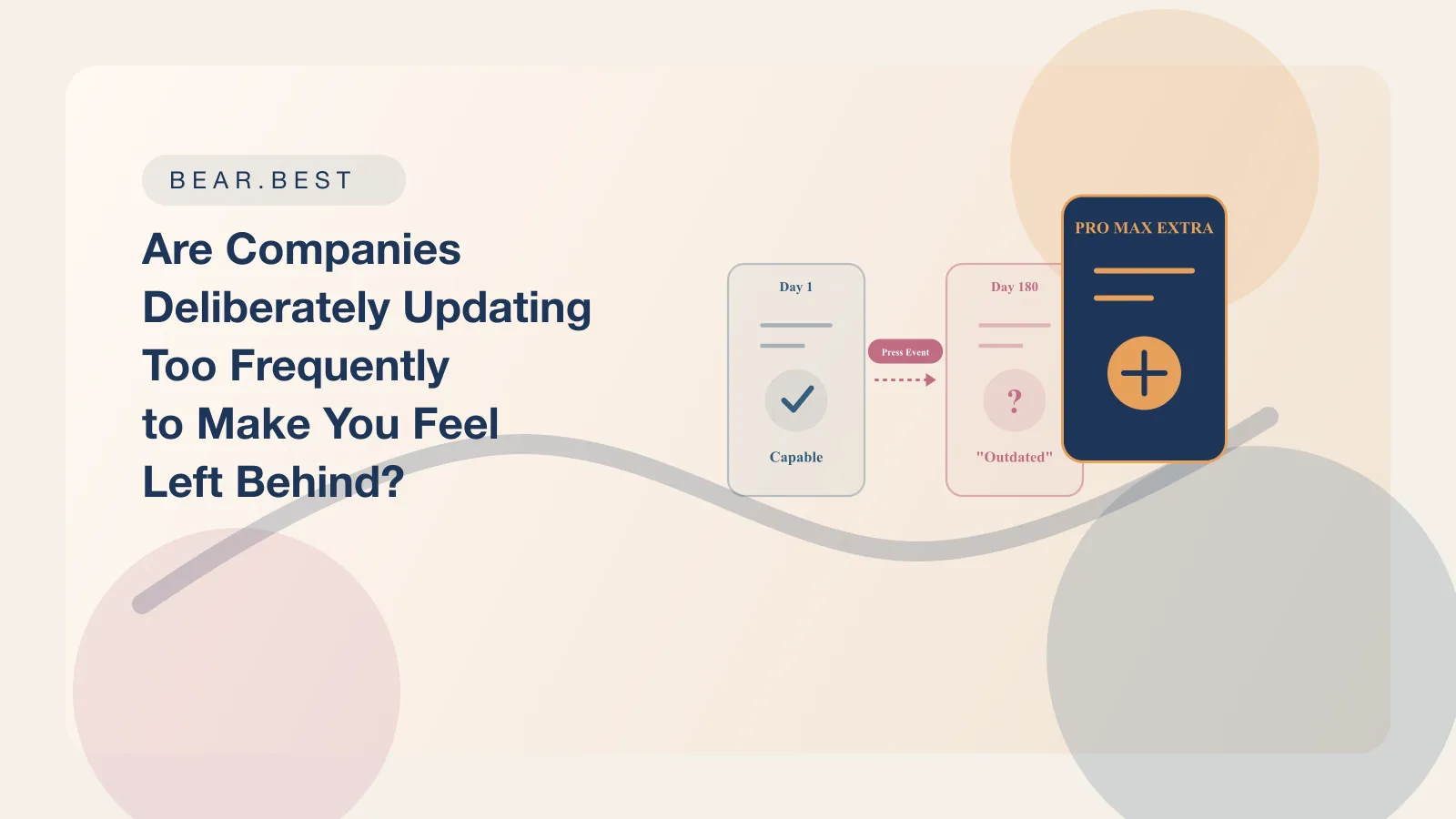
That feeling has become increasingly obvious in recent years, especially with gadgets and EVs. Upgrades were supposed to be need-driven. Your phone breaks, your laptop slows down, your car no longer fits your life, and that's when you pay for an upgrade. But in reality, more and more buying decisions have quietly been rewritten by a different logic: it's not that you need to upgrade, it's that the launch event is telling you that if you don't, you'll be left behind.
If you only take one point away from this piece, let it be this: this kind of obsolescence marketing is structurally very similar to scarcity marketing. Both work by manufacturing psychological pressure. One says, "Buy now or you'll fall behind." The other says, "Buy now or you'll miss your chance."
| Decision Logic | Trigger | Typical Feeling |
|---|---|---|
| Need-driven | The device is broken, too slow, or no longer fits the job | I need a better tool |
| Obsolescence marketing | A new model drops, specs improve, social feeds light up | Am I already falling behind? |
| Scarcity marketing | Limited release, countdowns, exclusive deals, flash sales | If I don't act now, will I lose the chance? |
Obsolescence Marketing and Scarcity Marketing Are Really the Same Kind of Playbook
Put more bluntly, I would argue that this so-called "feeling left behind" tactic is basically another form of obsolescence marketing, and it belongs to the same family of strategies as scarcity marketing.
The surface-level methods look different, but the underlying logic is almost identical. Neither begins by answering the most important question, which is: what concrete problem does this product solve for you? Instead, both begin by creating pressure and then using that pressure to accelerate your decision.
- Scarcity marketing creates scarcity pressure: buy now, or it will be gone.
- Obsolescence marketing creates replacement pressure: upgrade now, or you will look outdated.
One exploits the fear of missing out. The other exploits the fear of being left behind. One says supply is running out. The other says your identity is expiring. But both push consumers toward the same non-rational state.
Are Companies Really Trying to Manufacture a Sense of Being Left Behind?
My answer is: yes, but not necessarily in the conspiratorial sense. A more accurate way to put it is that this is the natural result of a highly optimized commercial system.
Once an industry enters maturity, truly transformative innovation doesn't happen every single year. But companies still need growth, attention, and a compelling story for the market. So the most reliable move is obvious: increase the update frequency and package every incremental revision as a lifestyle upgrade.
At that point, a product launch stops being just a product launch. It also becomes a machine for shaping perception and generating pressure:
- Specs create a performance gap.
- Marketing language creates a status gap.
- Social circulation creates a psychological gap.
Very often, a new model doesn't make the old one unusable. It just makes it feel less presentable. That's the subtle part. What companies are really selling isn't always that extra 15% of performance, a new color, or a few dozen more miles of range. Quite often, they're selling the feeling that you are still keeping up.
Seen from that angle, it is very close to scarcity marketing. Scarcity marketing uses limited stock, countdowns, queues, and urgency language to push you into a "buy now or lose out" mindset. Obsolescence marketing uses model generations, spec comparisons, launch cadence, and social chatter to push you into a "upgrade now or fall behind" mindset. In both cases, the real effect is the same: less room for calm judgment.
Why Gadgets and EVs Are Especially Good at This
Because both categories are exceptionally easy to compare.
Phones and laptops are filled with metrics that translate neatly into charts: chip generations, benchmark scores, brightness, battery life. EVs go even further: range, driver assistance, in-car software, charging speed. Every feature is ready-made content for comparison. You don't even need first-hand experience. A few short videos are enough to plant a suggestion in your head: the old model is not bad, it just feels outdated.
EVs add another layer on top of this: the whole narrative of the "software-defined car." People have already been trained to accept annual phone updates; now cars are increasingly marketed with a similar rhythm. That naturally magnifies the anxiety. The problem is that a car is not a phone. It's more expensive, depreciates harder, and has a much longer decision cycle. Once you're emotionally locked into the logic of "a new one every year," the cost is far higher than it is with consumer electronics.
To put it bluntly, after the cooling of the real-estate bubble, consumer society needed new growth stories. High-frequency tech products happen to be a very efficient one. They don't require the massive capital that housing once did, but they are still expensive enough, symbolic enough, and easy enough to amplify through content platforms. Once that machinery starts working smoothly, the harvest naturally moves downward to a much broader group of consumers.
What's Really Pushing Us to Upgrade Is Often Emotion, Not Need
When people talk about replacing a device, they usually talk about performance. But emotionally, something else is often doing the real work.
The real drivers are often harder to admit:
- Comparing yourself to someone already using the latest model.
- Feeling that an old device looks a little embarrassing, even though it still works.
- Worrying that you've missed a train everyone else seems to be boarding.
- Watching reviews, unboxings, and comparison videos until "still usable" starts to feel like "settling."
These emotions are not entirely fake, but they are very often amplified by commercial storytelling. A rational consumer asks: what exact problem does this new product solve for me? An anxious consumer asks: if I don't buy this, will I look out of date? That is very similar to the way scarcity marketing quietly replaces "Do I need this?" with "Can I still get this?"
Those are two very different questions, and they lead money in very different directions.
Ordinary Consumers Need Their Own Upgrade Threshold
The more I think about it, the more I feel that the most useful way to judge an upgrade is not to stare at launch events, but to ask yourself a few plain questions:
- Is my current device actually slowing down my work, my creative output, or my day-to-day life?
- Does the new product solve a recurring pain point, or does it simply look more advanced?
- If I don't upgrade, what do I truly lose? And if I do upgrade, what is the full cost I'm actually paying?
Take the MacBook Pro as an example. If your machine is still stable and powerful enough, its useful life can easily outlast the company's release cadence by a wide margin. For most people, replacing a laptop every three to five years isn't backward, and driving a car for many years isn't embarrassing. The truly absurd move is to mistake a company's shipping schedule for the rhythm your own life is supposed to follow.
Product managers and marketing teams are supposed to make you feel a purchase impulse faster. The rare skill on the consumer side is to translate that impulse back into an actual need. Whether the language is "limited," "ending soon," "all-new," or "next generation," the first step is still to strip away the pressure layer they are trying to insert between you and your judgment.
More Important Than Owning the Newest Model Is Refusing to Be Defined as Outdated
I have nothing against upgrading. Upgrades can be genuinely enjoyable, and better tools are often worth paying for. The only real question is this: are you paying for a real need, or are you paying for a manufactured feeling of being behind?
If an M2 Max still helps you do your work efficiently, then it is not some relic from a dead era. It is still a capable and productive tool. What deserves caution is not the fact that companies keep launching new products. It's the way repeated launch events, review videos, and social comparison slowly teach us to see "good enough" as failure and restraint as backwardness.
Companies will keep updating, because that is their business. And just as companies manufacture scarcity, they can also manufacture obsolescence, because both help trigger purchases. But as users, we can still keep one basic right for ourselves: we do not have to turn someone else's growth target into our personal anxiety, and we do not have to mistake a marketing strategy for a real need.